Introduction
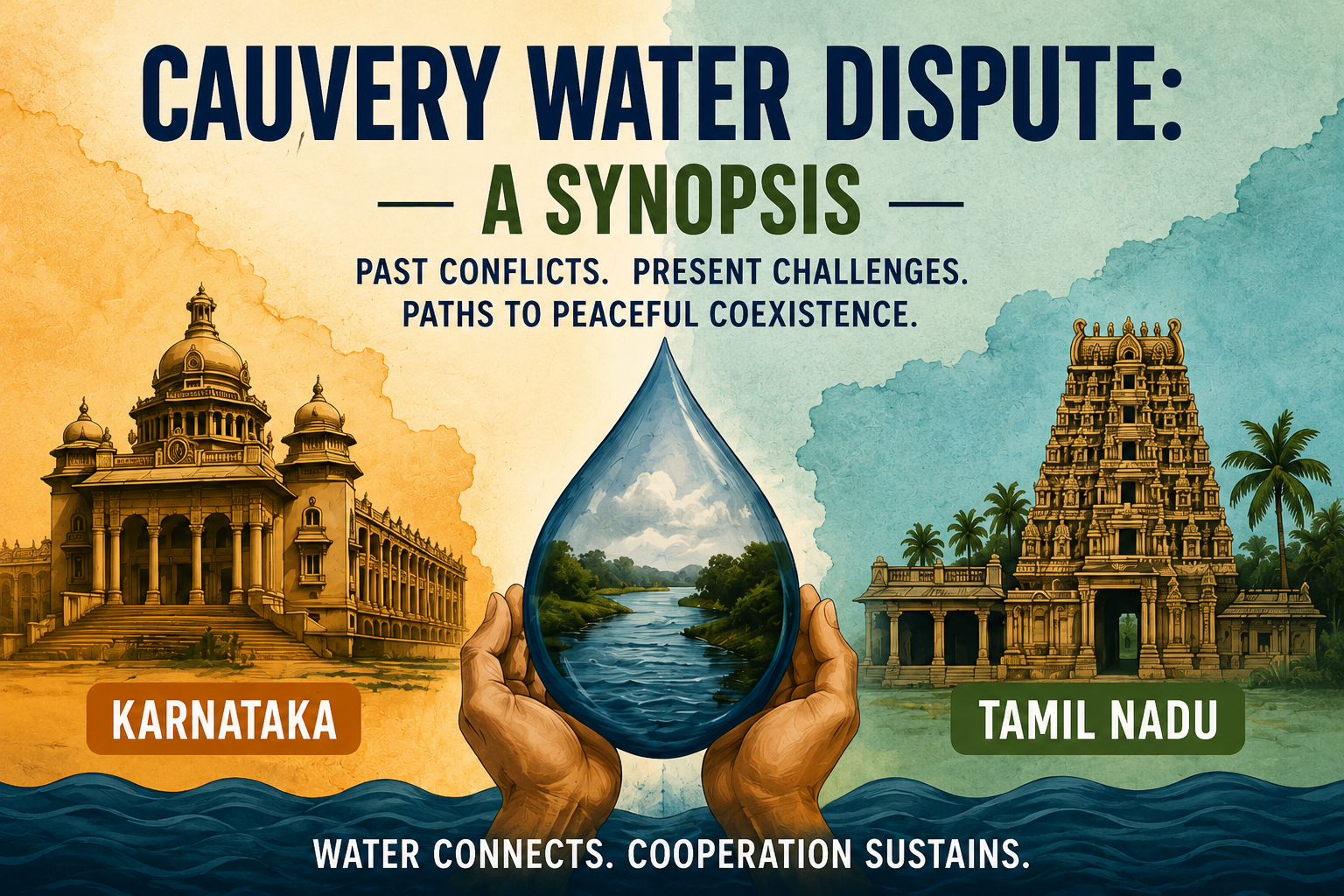
India is yet majorly an agrarian economy. A large population of India is dependent upon agriculture directly or indirectly. Though, Indian agriculture is still a rainfed agriculture river and groundwater are also important sources of water. If farmers are in a command area of a dam, they use river water for irrigation. Thus, making rivers an important source of water for various farmers. These rivers flow through various states, giving rise to interstate water distribution disputes. Cauvery or Kaveri water dispute is one of India’s oldest and is still far from completely resolved.
Geographical Information About Kaveri
Kaveri is one of the most important rivers in peninsular India. It is the fourth largest river basin in Southern India after Godavari, Krishna, and Mahanadi. It originates at Talacauveri in the Kodagu district of Karnataka and ends its journey in the Bay of Bengal at Kaveri Patanam in Tamil Nadu. It covers 802 km during this journey. It travels 381 km in Karnataka, 64 km on the border of Karnataka and Tamil Nadu, and 357 km in Tamil Nadu (Midatala 2002). The part of the basin also falls slightly in Kerala and the Union Territory of Pondicherry (Puducherry). Still, Karnataka and Tamil Nadu are the key states in this dispute case.
History of the Kaveri Water Dispute
The Kaveri water dispute has a long history of nearly over 130 years. As Kaveri is an important river in Southern India, it has been used by various kingdoms throughout the course of history. Kaveri was also used for political rivalries right from Wodeyar of Mysore against Naik of Madurai in Tamil Nadu (Midatala 2002).
Karikal Cholan built the Grand Anicut and developed a large irrigation canal system. Around 1600 km of canal network was developed with 36 distributaries and covering an area of around 14 lakh acres, which accounted for 47% of irrigation in Tamil Nadu (Midatala 2002)
The history of the Kaveri water dispute is very long. Hence, we can see it as a timeline of events.
| Timeline of Kaveri water dispute | |
| 1807 |
The Princely State of Mysore tried to increase the land under irrigation and the British Presidency of Madras objected to it on the grounds of a breach of Easementary Rights. Sri Seshadri Iyer the tenth Dewan of Mysore replied by submitting a memorandum to the then Resident of Mysore. |
| 1890 | A conference of both the parties |
| 1892 |
An agreement between both parties, making it mandatory for both parties to-
|
| 1910 |
Submission of developmental plans and beginning of discussions
|
| 1924 |
A milestone agreement, with an expiry of 50 years.
|
| 1960-70 |
Multiple meetings between Karnataka and Tamil Nadu and many of them triparty meetings with the presence of the Union Minister for Irrigation. No outcome. |
| 1986 | Tamil Nadu formally requested Union Government to set up a tribunal under Inter State Water Dispute (ISWD) Act, 1956 |
| 1990 | Cauvery Water Dispute Tribunal (CWDT) was established |
| January 1991 |
Tribunal gave its Interim Order (IO)1
|
| 1995-96 |
Monsoon failed after three years. Tamil Nadu (TN) goes to SC seeking the release of 30 TMC. SC sends TN back to the tribunal. Tribunal orders release of 11 TMC. Karnataka (KA) did not follow the order hence TN is back in SC. SC requests the PM to intervene and the PM intervenes by setting up an all- party committee, following which KA agrees to release 6 TMC of water. (Ghosh, Bandyopadhyay and Thakur 2018) |
| 1998 |
Establishment of Cauvery River Authority (CRA), to pursue the implementation of IO, 1991. With the Chairperson as Prime Minister and chief ministers of basin states and Pondicherry, CRA failed to achieve its objectives (Ghosh, Bandyopadhyay and Thakur 2018) |
| 5 February 2017 |
Final award by the tribunal. The water was distributed as follows with consideration of the availability of usable water as 740 TMC with 50% of dependability.
|
Tamil Nadu wanted IO to get published in the gazette and get it implemented immediately, but Karnataka felt the IO was unjust. Karnataka issued an ordinance and tried to nullify the IO. It failed to comply with IO pushing the Government of India to take the Supreme Court legal opinion. SC gave its opinion in the favour of IO. Karnataka felt the IO was unimplementable and hence it referred to the tribunal. Tribunal reaffirmed its order and observed that situations of abnormally low flows could be dealt with when they arise and that a pro-rata adjustment could be made (Iyer 2003). After 1990, there was a good monsoon for three consecutive years. Things were different when the monsoon failed in 1995-96. With the failure of the southwest monsoon tensions between Tamil Nadu and Karnataka increased.
This problem continues today. In the later years on different occasions, Karnataka was directed to release different amounts of water for Tamil Nadu. Recently, in 2017 Tamil Nadu was facing droughts once again and was demanding water from Karnataka. Fortunately, the monsoon coming back on time gave relief and the problem was managed. Yet, it is far from a sustainable solution.
Discussion on the Kaveri Water Dispute
Since rivers cross state boundaries, disputes are inevitable (Richards and Singh 2001). Water is a fugitive resource that cannot be easily contained by political boundaries or property rights (Anand 2004). Inter-state water disputes study needs a different approach than international water disputes. In the case of interstate water disputes federal government, the Constitution and the supreme court can provide legal measures to solve the dispute. Here, the scope of escalating the water dispute into an armed forces conflict is not available (Anand 2004). Hence, it is important to understand inter-state water disputes in a constitutional context and the theories behind the water conflicts.
Water in Constitutional Structure
In India, water is not included in the concurrent list, but it has separate mentions in the constitution ‘Entry 17 in the State List’, ‘Entry 56 in the Union List’, and ‘Article 262’. The first provision makes water a state topic (Richards and Singh 2001). At the same time, entry 56 in the Union list states: -
"Regulation and development of inter-state rivers and river valleys to the extent to which such regulation and development under the control of the Union are declared by Parliament by law to be expedient in the public interest.” (Richards and Singh 2001)
Thus, the Constitution gives states the upper hand in the case of water. Article 262 in the constitution grants parliament the right to legislate over the matters in Entry 56 and also gives primacy over the Supreme Court. The Inter-State Water Disputes Act of 1956 was legislated to deal with conflicts and included provisions for the establishment of tribunals to adjudicate where direct negotiations have failed. (Richards and Singh 2001).
Theories, Principles and Philosophy in Water Conflict
According to a study of 49 international water treaties and accords by Giordano and Wolf, co-riparians tend to develop practices keeping in view basin-specific characteristics. They also suggested that the disputes begin with ‘rights-based’ claims by upper riparian and lower riparian and gradually it shifts to ‘needs-based’ allocation requirements (Anand 2004). We see a similar development in the case of the Kaveri water conflict as well.
Historically when the Mysore government tried to develop their irrigation, it was objected on the grounds of breach of ‘Easementary Rights’ of Tamil Nadu (then British Presidency of Madras), invoking the principle of ‘prior appropriation’ (Anand 2004, Midatala 2002). In the later years, it also became a part of arguments by Tamil Nadu. In the later period, the petitions filed by Tamil Nadu highlight the shift of conflict from ‘right-based’ to ‘need-based.’
On the other hand, Karnataka had earlier invoked the principle of ‘absolute sovereignty’ or ‘Hamon Doctrine.’ Whereby, Karnataka had claimed on Kaveri River as an upper riparian. Another issue of ‘power asymmetry’ can be observed in the Kaveri water dispute case. Earlier Karnataka was the Princely State of Mysore and Tamil Nadu was the British Presidency of Madras2. Therefore, the relationship between the parties was like the federal state and central government. This power asymmetry in later years became one of the arguments presented by Karnataka, where it claimed that ‘…the 1924 agreement was made at a time when T was under the British rule and K was under Maharaja’s administration when K did not have the freedom to argue strongly to put forth its interests.’ (Anand 2004).
These principles were about the power and distribution of the gross amount of water within states. In the Kaveri water dispute, we also the conflict between the distribution of water, within various sectors. In the last few years, there has been a change in water demand by both states because of development in urbanization, industrialization, and increased area under irrigation. In Tamil Nadu, three cropping seasons are called ‘kuruvai,’ ‘thaladi’ and ‘samba’ (Janakarajan 2016). Also, Tamil Nadu is more industrialized than Karnataka. On the other hand, a large city like Bengaluru is highly dependent upon the Kaveri water supply as its main water source. This has given rise to sectoral water distribution conflict.
Possible Ways Forward
We have seen through various instances that, the conflict between Karnataka and Tamil Nadu erupts during the years when the monsoon has failed and there is a lack of water availability. The solution needs to find out to mitigate the water crisis. At the same time, both states need to adapt to changes at various levels.
In the first place, the central level of water is shifted to the concurrent list there are chances that parliament may get more powers to intervene in the conflict. On the contrary, if the parliament is having coalition government with the ruling party in any of the states in the coalition, can hinder the parliament’s ability to intervene in the conflict. An authority like CRA would be useful. Earlier CRA was established, but it was unable to bring changes. CRA with more implementation power can bring changes in the basin. Changing water from the state list to the concurrent list will have other collateral effects. Therefore, this step can be taken with more legal advice.
Anand (2004) has explained when the disputant parties can meet an agreement. The writer says, Olson’s seminal analysis suggests that collective action will take place only if benefits to the individual agents exceed costs to themselves. This means, whether or not two riparian states will cooperate depends on:-(a) whether the river is the only transaction between them; (b) if not, whether there is any issue-linkage; and (c) if so, whether the issues are considered in a compensating framework or whether they are considered to be discrete entities (Anand 2004). In Kaveri’s case, with the help of a third party, both states can find something which is also being traded between both states. During the 1970’s against the release of additional water to Tamil Nadu, Karnataka demanded a supply of power from Tamil Nadu at a concessional rate. Similarly, another important commodity can be looked upon to trade and can be used as a means to establish peace between the two states.
Both states are paddy-cultivating states. In Tamil Nadu, crops are cultivated over three seasons. For a long time, Tamil Nadu is using flood irrigation to irrigate its crops. With the development in technology, new water-saving techniques of irrigation must be practised. Also, both states can promote other water-saving crops like millet. Civil society dialogue bodies like Cauvery Family (with some more political backing and with some more legal power and structure) would be helpful to plan the crops in the given farming season. This may help to plan the water demand.
We have seen how the aspect of asymmetry plays in the case of inter-state river disputes. Indus water treaty successfully mitigated this asymmetry by converting it into symmetry by treating each tributary as a single unit and allocating in its entirety to one of the parties (Anand 2004). If possible, this technique can be applied to the Kaveri water dispute. The tributaries of Kaveri, which originate from various locations, after a detailed study can be treated as an independent unit and allocated to each state for development. Along with tributaries, both states can explore other water sources in the basin. E.g., Karnataka can look for other water sources to provide water to large cities like Bengaluru. On the other hand, Tamil Nadu can look for an alternative source for its vastly developed industries.
In the end, I can say that it is difficult to find a one-line solution for the Kaveri dispute. Both states need to implement changes, explore new sources, make some compromises on various levels and implement new technology from the grassroots level. If both states willingly take up the challenge and bring changes on the demand side, there could be some hope of finding a way out.
References
- Anand, P. B. 2004. Water and Identity: An Analysis of the Cauvery River Water Dispute. Bradford Center for International Development, University of Bradford, Bradford Center for International Development. https://bradscholars.brad.ac.uk/handle/10454/2893.
- Ghosh, Nilanjan, Jayanta Bandyopadhyay, and Jaya Thakur. 2018. Conflict over Cauvery Waters: Imperatives for Innovative Policy Options. New Delhi: Observer Research Foundation. https://www.orfonline.org/wp-content/uploads/2018/09/ORF_Monograph_Cauvery.pdf.
- Iyer, Ramaswami R. 2003. “The Cauvery Dispute.” In Water: Perspectives, Issues, Concerns, by Ramaswami R. Iyer, 39-49. SAGE Publications India Pvt. Ltd.
- Midatala, Rani. 2002. “Historical Background of the Cauvery Water Dispute.” Proceedings of the Indian History Congress (Indian History Congress). https://www.jstor.org/stable/44158173.
- Richards, Alan, and Nirvikar Singh. 2001. “Inter States Water Disputes in India: Institutions and
- Policies.” Department of Environmental Studies & Department of Economics. Santa Cruz: University of California, October. https://econwpa.ub.uni-muenchen.de/econ-wp/dev/papers/0412/0412010.pdf.